
Composite Doors Enfield – Supply & Installation
Your front door is the first thing visitors see and the last line of defence between your home and the outside world. If your current door is draughty, difficult to secure, or simply looking tired, a composite door replacement makes an immediate and lasting difference to both the security and appearance of your property.
At Urgent Windows, we supply and install composite doors across Enfield, covering EN1, EN2, and EN3. We install composite front doors, composite back doors, and composite stable doors for homes across Bush Hill Park, Palmers Green, Edmonton, Southgate, and the wider Enfield area. Every door we fit is made to measure, installed by our own team, and backed by a full workmanship guarantee.
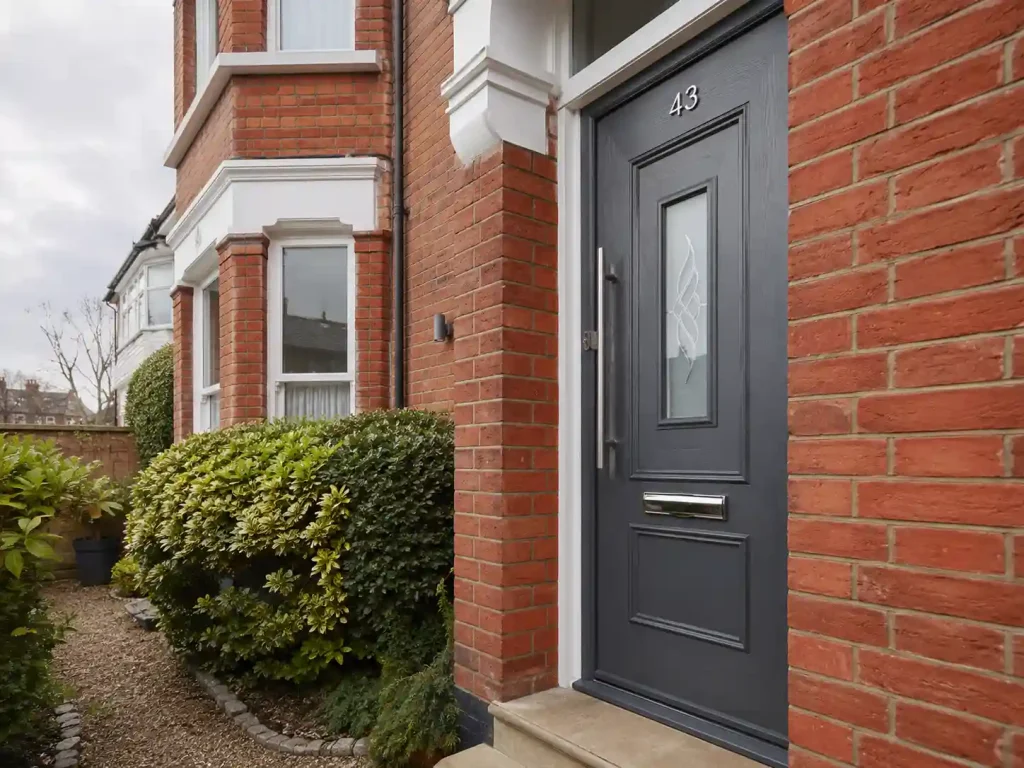
Composite doors combine multiple materials in a single construction to produce a door that is significantly stronger, better insulated, and more durable than a standard timber or uPVC door.
They are available in a wide range of colours, styles, and hardware options, making it straightforward to find a door that suits both the character of your property and your personal preference.
What is a composite door?
A composite door is made from a combination of different materials, each selected for a specific purpose within the overall construction.
Unlike a standard timber or uPVC door that is made from a single material throughout, a composite door layers different materials together to produce a door that performs better in every area, strength, insulation, weather resistance, and appearance, than any single material could achieve alone.
The layers that make up a composite door
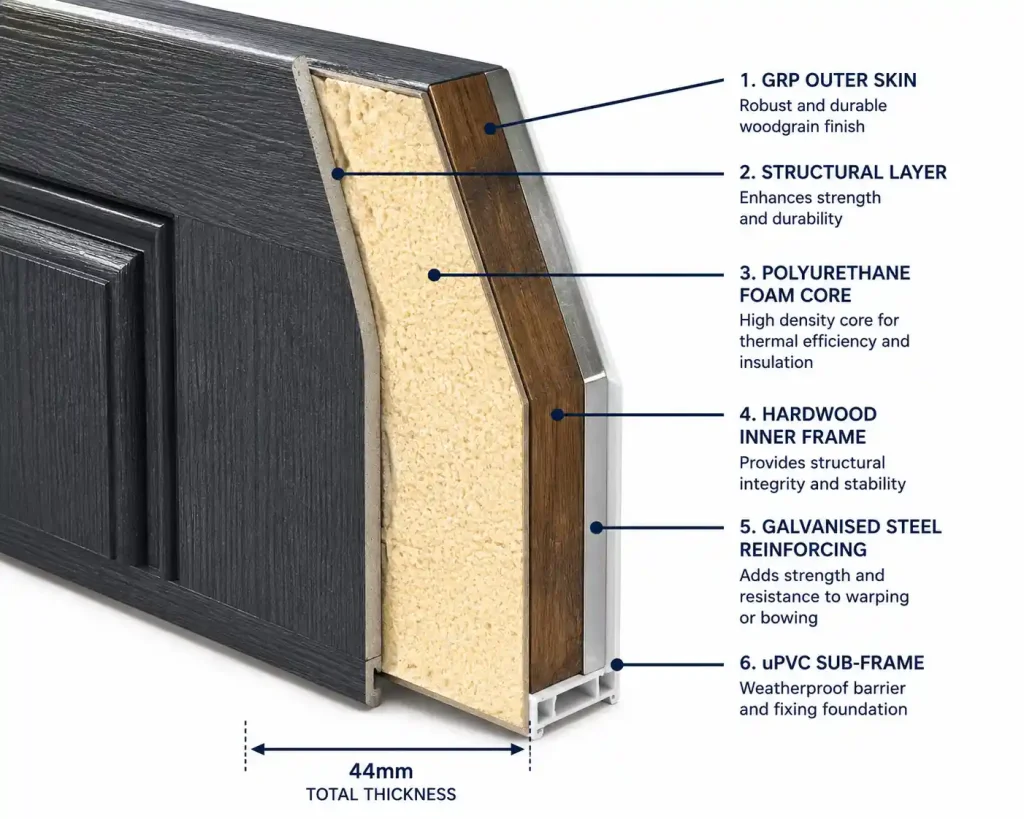
GRP outer skin
Glass-reinforced plastic forms the outer face of the door. GRP is exceptionally hard-wearing, resistant to impact, abrasion, and weathering, and can be moulded to replicate the grain and texture of natural timber with a level of realism that uPVC cannot match. Unlike real timber, GRP does not warp, crack, fade, or require painting, and retains its appearance reliably over the lifetime of the door.
Polyurethane foam core
The interior of the door is filled with high-density polyurethane foam, the same insulating material used in high-performance building insulation panels. This foam core is responsible for the exceptional thermal performance of composite doors, significantly reducing heat transfer through the door compared to a hollow or solid timber alternative.
Hardwood inner frame
A solid hardwood timber frame runs around the perimeter of the door leaf, providing structural rigidity and giving the door its solid, substantial feel when opened and closed.
The hardwood frame also provides the fixing points for the locking hardware, ensuring the multi-point locking system is anchored into solid material rather than foam.
Galvanised steel reinforcement
Steel reinforcing is integrated into the door construction to add torsional rigidity and resistance to forced entry attempts. The combination of GRP skin, hardwood frame, and steel reinforcement creates a door leaf that is significantly more resistant to physical attack than a standard timber or uPVC door.
uPVC sub-frame
The outer frame into which the door leaf hangs is a multi-chamber uPVC profile, providing thermal insulation around the perimeter of the door opening and ensuring a weathertight seal when the door is closed.
Together these five layers produce a door with a standard leaf thickness of 44mm, considerably thicker and more substantial than a standard timber door, and a construction that addresses every weakness associated with single-material front doors.
Security
Security is the primary reason most homeowners in Enfield choose a composite door, and it is where composite doors genuinely outperform every other front door type available.
The combination of materials, construction, and hardware creates a door that is significantly more resistant to forced entry than a standard timber or uPVC alternative.
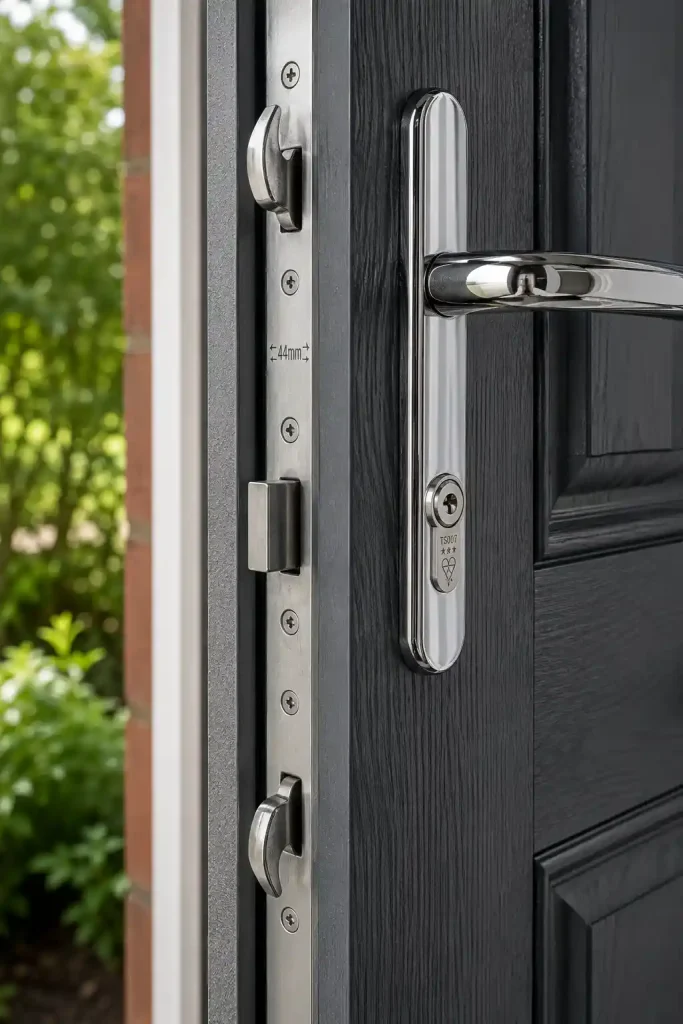
Multi-point locking
Every composite door we install features a multi-point locking system that engages at multiple points around the door frame simultaneously when the door is locked.
Rather than a single central deadbolt, the locking mechanism deploys hook bolts at the top and bottom of the door and a deadbolt at the centre, securing the door at four or more points around the frame.
This distributes resistance across the full height of the door, making it significantly harder to force open by kicking or levering than a single-point lock.
PAS24 and Secured by Design
Our composite doors meet the requirements of PAS24, the British Standard for enhanced security performance in doors and windows.
PAS24 certification requires the door to pass a series of independently tested forced entry scenarios, including attacks on the locking mechanism, the glazing, the hinges, and the door leaf itself.
Many of our composite doors also carry Secured by Design approval, the UK police-backed initiative that endorses products proven to resist the most common methods of opportunistic residential burglary.
What these standards mean for your insurance
Fitting a Secured by Design or PAS24 certified composite door can have a direct impact on your home insurance. Many insurers recognise these standards and either require certified door and window products as a condition of cover or offer reduced premiums for properties fitted with them.
If your existing front door does not meet current security standards, replacing it with a certified composite door may be one of the most cost-effective security improvements you can make.
The cylinder matters as much as the lock
The lock cylinder is the component most targeted in lock-snapping attacks, where a burglar uses force to snap the cylinder and gain direct access to the locking mechanism. Standard cylinders are vulnerable to this method.
We recommend and install anti-snap, anti-pick, and anti-drill cylinders as standard on all our composite door installations. A 3 star cylinder, rated to TS007, provides the highest available protection against cylinder attacks and is worth specifying for any front door in a residential street.
Toughened and laminated glass
Where composite doors include glazed panels, the glass is toughened safety glass as standard, which resists impact and breaks into blunt fragments rather than sharp shards if damaged.
Laminated glass is available as an upgrade and adds a further layer of security, as the interlayer holds the glass together even when broken, preventing easy access through a glazed panel.
Association of British Insurers compliance
All locking systems on our composite doors comply with the Association of British Insurers requirements, ensuring they meet the minimum security standard recognised by the UK insurance industry.
This is an important practical consideration, as a door lock that does not meet ABI standards may invalidate a home insurance claim following a break-in.
Door styles for every Enfield property
Choosing the right composite door style is about more than personal preference. The door needs to suit the architectural character of the property, complement the surrounding streetscape, and in some cases meet the requirements of a conservation area or the expectations of a housing estate covenant.
Enfield’s varied housing stock means that different areas of the borough call for quite different door styles.
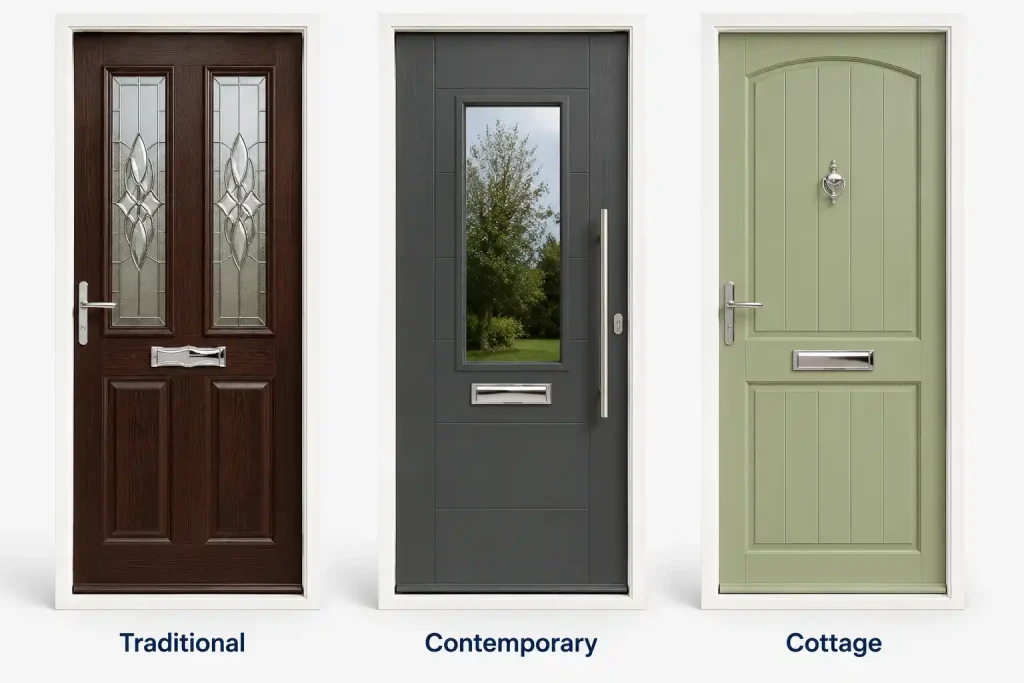
Traditional and period styles
The Victorian terraces of Bush Hill Park, the Edwardian semis of Palmers Green and Winchmore Hill, and the period properties around Enfield Town and Chase Side all suit traditional composite door designs.
These doors typically feature raised and fielded panel layouts inspired by Georgian and Victorian joinery, decorative glazing with lead detailing or period glass patterns, woodgrain finishes in oak or darkwood, and hardware in chrome, gold, or antique finishes that complement the character of the surrounding architecture.
For period properties on conservation-sensitive streets, a traditional composite door in a heritage colour, cream, darkwood, or a deep solid colour, with appropriate period hardware is the most sympathetic choice and the one most likely to sit naturally within the existing streetscape.
Contemporary styles
Modern and post-war properties across Edmonton, Grange Park, and the newer residential developments in Enfield benefit from contemporary composite door designs.
These doors feature cleaner panel layouts with less decorative detailing, larger or more geometric glazing panels, and bold colour choices. Anthracite grey and black are the most popular contemporary choices, both of which create a strong visual contrast against brick or render and give the property a sharp, updated appearance from the street.
Contemporary hardware choices, long bar handles, brushed steel or graphite finishes, and minimal letter plate designs, complement the cleaner aesthetic of modern door styles and are available across most of our composite door range.
Cottage and stable style
Cottage-style composite doors suit semi-detached and detached properties where a more relaxed, less formal entrance is appropriate.
These doors often feature arched glazing panels, softer colour choices such as chartwell green, duck egg blue, or cream, and traditional hardware in chrome or black.
They work particularly well on 1930s and 1940s semis, a common property type across Winchmore Hill, Southgate, and the quieter residential streets of Enfield’s outer neighbourhoods.
Composite stable doors, where the upper and lower sections of the door operate independently, are a natural companion to the cottage style and are covered in more detail in the stable doors section below.
Glazing options
The glazing panel in a composite door affects both the appearance and the privacy of the entrance. Options include clear glass for maximum light, obscure or frosted glass for privacy on ground floor doors facing the street, decorative leaded glass in traditional or contemporary patterns, and sealed unit glazed cassettes that can be replaced if the glass is damaged without removing the door from its frame.
Colours, finishes, and hardware
One of the most significant advantages of composite doors over standard timber or uPVC is the range of colours, finishes, and hardware options available.
A composite door can be specified to look exactly right for the property it is going on, whether that means a classic painted timber appearance for a Victorian terrace or a bold contemporary finish for a modern new build.
Door colours
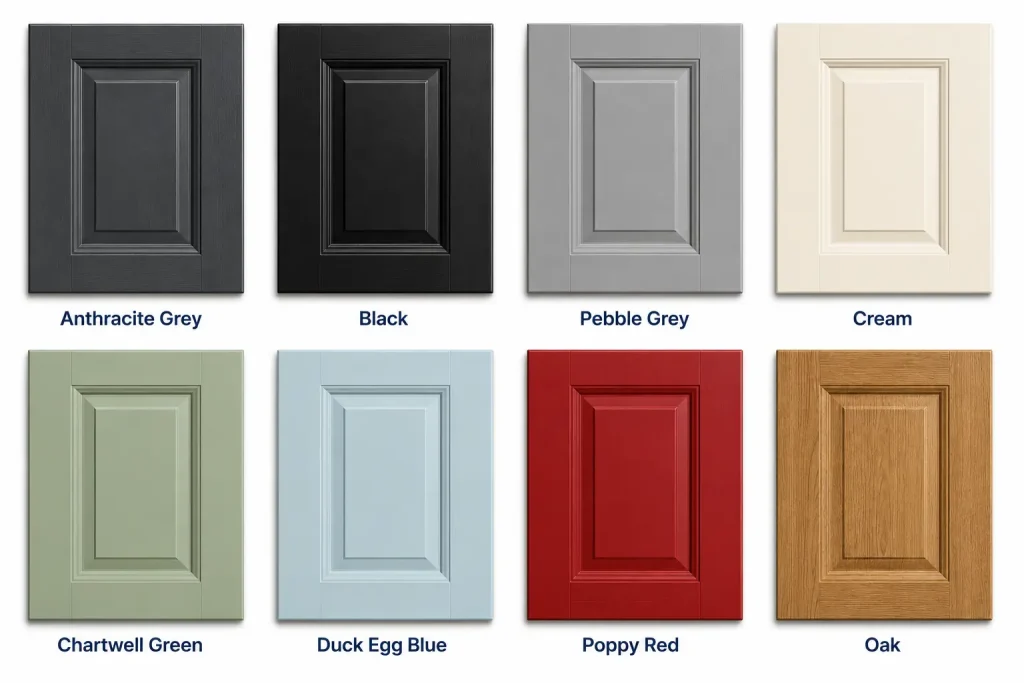
Composite doors are available in a wide range of solid and woodgrain colours. The most popular choices for Enfield properties are,
- Anthracite grey, the most widely specified contemporary colour, works well on both modern properties and period homes where a bold contrast against brick is desired. One of the most searched composite door colours in the UK for good reason, it creates an immediately striking entrance.
- Black, a stronger, deeper alternative to anthracite grey that suits contemporary properties and makes a confident statement from the street. Works particularly well on properties with white or light rendered facades.
- Grey, available in lighter shades including pebble grey, agate grey, and slate grey for homeowners who want a contemporary finish without the depth of anthracite or black.
- Cream, a softer, warmer finish suited to period properties and cottage-style homes across Winchmore Hill, Southgate, and the quieter residential streets of Enfield’s outer neighbourhoods.
- Chartwell green, a soft sage green that has grown significantly in popularity for both period and contemporary properties. Works well on brick facades and is increasingly seen across Enfield’s Edwardian and interwar housing stock.
- Duck egg blue, a light, characterful colour that suits cottage-style and period properties. Less common than grey or green, making it a distinctive choice for homeowners who want something individual without being unconventional.
- Poppy red, a bold, traditional choice for front doors that creates strong kerb appeal on period properties. Associated with a confident, classic British entrance and works best on properties with darker brick tones.
- Woodgrain finishes including oak, darkwood, rosewood, and mahogany, available for homeowners who want the warmth and texture of a timber appearance without the maintenance requirements. The GRP outer skin replicates the grain and texture of real timber convincingly and is the closest modern alternative to a painted timber door.
Dual colour options
Composite doors can be specified with different colours on the inside and outside, allowing the exterior colour to complement the street-facing facade while the interior colour matches the hallway decoration.
This is a practical option for homeowners who want a bold exterior colour, anthracite grey or black, with a lighter, softer interior finish that suits the inside of the home.
Hardware
The hardware on a composite door, handle, letter plate, knocker, cylinder, and numerals, is where the details that define the entrance come together. Options include, Lever handles in lever-lever and lever-pad configurations for standard composite doors, and long bar handles and pull escutcheons for contemporary minimal designs. Available in chrome, gold, black, graphite, and brushed steel finishes.
Letter plates in matching hardware finishes, with or without an internal draught seal. A letter plate with an internal seal reduces heat loss through the door opening and adds to the thermal performance of the overall installation. Door knockers available in traditional and contemporary designs, with or without an integrated spy hole for added security and convenience.
Door numerals in chrome, gold, and black finishes, allowing the house number to be presented clearly and consistently with the rest of the hardware suite. Security chains as an additional internal security measure for homeowners who want to verify callers before fully opening the door.
Cylinder upgrades including anti-snap, anti-pick, and anti-drill 3 star TS007 rated cylinders for maximum protection against lock-snapping attacks, covered in more detail in the security section above.
Thermal efficiency
While security is the primary reason most homeowners replace their front door, the thermal performance of a composite door is a significant secondary benefit that becomes immediately noticeable after installation, particularly in hallways and ground floor rooms adjacent to the entrance.
Why composite doors insulate better
The polyurethane foam core at the heart of every composite door is a highly effective thermal insulator. Unlike a solid timber door, which conducts heat through the wood, or a hollow uPVC door panel, which relies on trapped air in a thin cavity, a composite door fills the entire door leaf with dense insulating foam.
This significantly reduces heat transfer through the door itself, keeping the hallway warmer in winter and reducing the cold draught that is characteristic of older, poorly insulated front doors.
The uPVC multi-chamber outer frame adds a further layer of insulation around the perimeter of the door opening. The multi-chamber profile traps air within the frame sections, slowing heat transfer at the edges of the door where single-material frames typically lose the most heat.
U-value and Building Regulations compliance
Replacement external doors in England must comply with Approved Document L of the Building Regulations, which sets minimum thermal performance requirements for new door installations.
Our composite doors meet and exceed these requirements, with U-values that comply with current Part L standards. As a FENSA-registered installer, we self-certify compliance with Approved Document L on every composite door installation, removing the need for a separate building control application.
Practical benefits
The improvement in thermal performance after replacing an old timber or uPVC door with a modern composite is most noticeable in three ways.
The hallway feels warmer in winter because the door is no longer a significant source of heat loss. Draughts around the door frame are eliminated by the compression seals on the composite door frame, which close tightly when the door is shut and maintain their performance over time without the warping and swelling that causes draughts in timber door frames.
And heating costs reduce modestly as the front of the house retains heat more effectively, particularly in properties where the front door opens directly into a living space rather than a separate hallway.
Glazed panels
Where the composite door includes glazed panels, the glass specification affects the overall thermal performance of the door. Sealed double-glazed units are standard, with low-emissivity glass and argon gas filling available as an upgrade for maximum thermal performance.
For properties where the glazed panel is large relative to the overall door area, specifying an energy-efficient glazing unit makes a meaningful difference to the door’s overall U-value.
Composite doors vs uPVC doors, which is better?
If you are replacing a front or back door and weighing up composite against uPVC, the honest answer for most homeowners in Enfield is that composite is the better choice for a front door and uPVC remains a reasonable option for back doors and side access where security and appearance are less critical.
What uPVC doors do well
uPVC doors are lighter than composite doors, easier to manufacture to non-standard sizes, and lower in upfront cost. For back doors, utility room access, and side gates where the door is not the primary entrance and kerb appeal is not a consideration, a uPVC door provides adequate performance at a lower price point. uPVC doors also perform reasonably well on thermal efficiency thanks to the multi-chamber frame construction, and they require no painting or regular maintenance.
Where composite doors are significantly better
Security is the clearest difference between composite and uPVC. A standard uPVC door uses a hollow door panel over a uPVC frame, which provides less resistance to forced entry than the solid 44mm composite door leaf with its hardwood inner frame, galvanised steel reinforcement, and GRP outer skin.
The multi-point locking system on a composite door anchors into solid hardwood rather than uPVC, which is a meaningful difference when the locking points are subjected to the force of a kick or lever attack.
Appearance is the second significant difference. The GRP surface of a composite door replicates the grain and texture of real timber convincingly and maintains its appearance without painting, fading, or discolouring.
A uPVC door has a smoother, more uniform surface that reads as clearly synthetic at close range, which matters for front doors on period properties and any entrance where kerb appeal is a priority.
Durability is the third difference. Composite doors have an average lifespan of around 35 years with minimal maintenance. uPVC doors typically last 20 to 25 years before the surface begins to discolour and the seals and locking mechanism require replacement.
Over the lifetime of the property, the lower replacement frequency of a composite door offsets a significant portion of its higher upfront cost.
The practical recommendation
For a front door on any residential property in Enfield, composite is the right choice. The security advantage alone justifies the additional cost, and the appearance, thermal performance, and lifespan benefits reinforce that decision further.
For back doors, side access, and utility entrances where security and kerb appeal are secondary considerations, uPVC remains a cost-effective option. We install both and are happy to advise on the most appropriate choice for each opening during a free consultation.
Low maintenance and durability
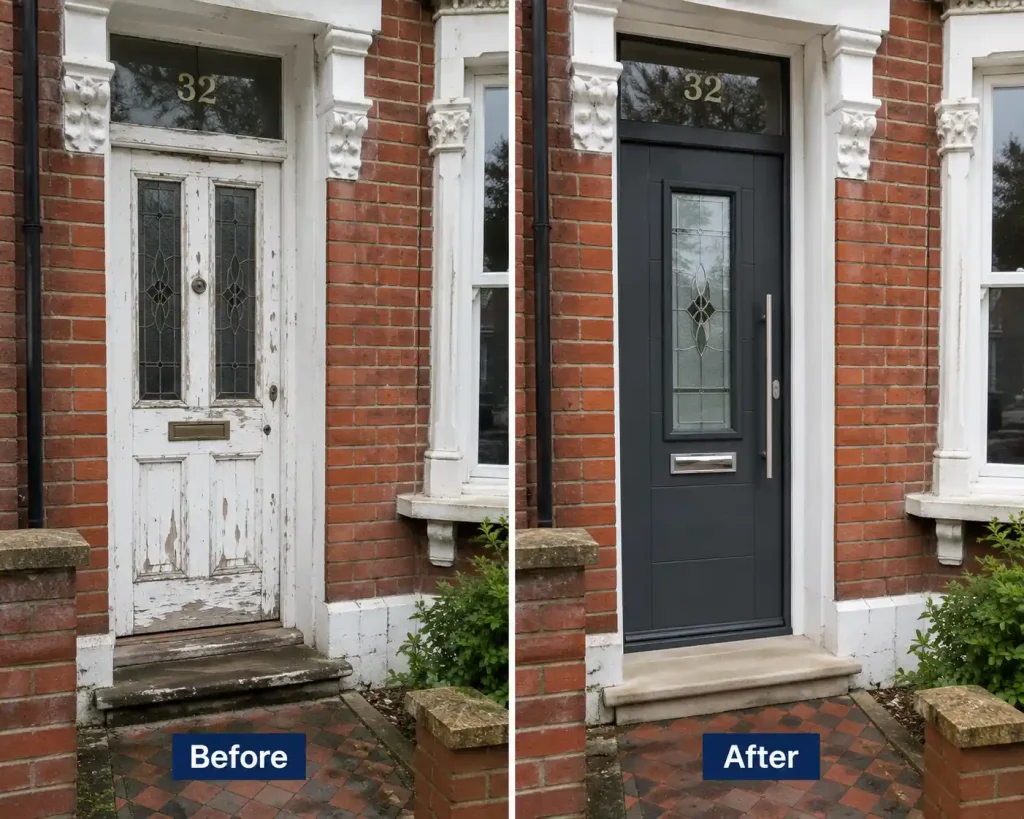
One of the most practical advantages of a composite door is how little attention it requires once installed. For homeowners replacing original timber front doors that have needed repainting every few years, the contrast is immediate and significant.
No painting, ever
The GRP outer skin of a composite door does not need painting at any point during its lifespan. The colour is integral to the surface material rather than applied as a coating, which means it does not peel, flake, crack, or fade in the way that painted timber or painted uPVC surfaces do over time.
A composite door installed today should look substantially the same in twenty years without any surface treatment, which represents a genuine saving in both time and ongoing maintenance cost compared to a timber door.
No warping, swelling, or rotting
Timber front doors are susceptible to moisture absorption, which causes the door to swell in damp conditions, stick in the frame, and in severe cases warp or rot at the base where moisture accumulates. Composite doors are not affected by moisture in the same way.
The GRP skin is impermeable, the polyurethane foam core does not absorb water, and the hardwood inner frame is fully encapsulated within the door construction and protected from direct moisture exposure. The door leaf maintains its shape and dimensions throughout the year regardless of seasonal changes in temperature and humidity.
Cleaning and day-to-day care
Composite doors require nothing more than an occasional wipe-down with a damp cloth and mild detergent to keep the surface clean and looking its best.
Hardware, handles, letter plates, and cylinders benefit from an occasional check and light lubrication to keep the mechanism running smoothly. Beyond this, there is nothing a homeowner needs to do to maintain a composite door under normal operating conditions.
Lifespan
The average lifespan of a composite door is around 35 years, considerably longer than a standard timber door which typically requires replacement after 20 to 25 years even with regular maintenance.
The locking mechanism and hardware may need servicing or replacing at some point during the door’s life, but the door leaf and frame themselves should remain in good functional and visual condition throughout.
This longevity makes composite doors a genuinely cost-effective long-term investment, particularly when the saving on maintenance costs and the reduced replacement frequency are factored into the comparison with timber alternatives.
Composite stable doors
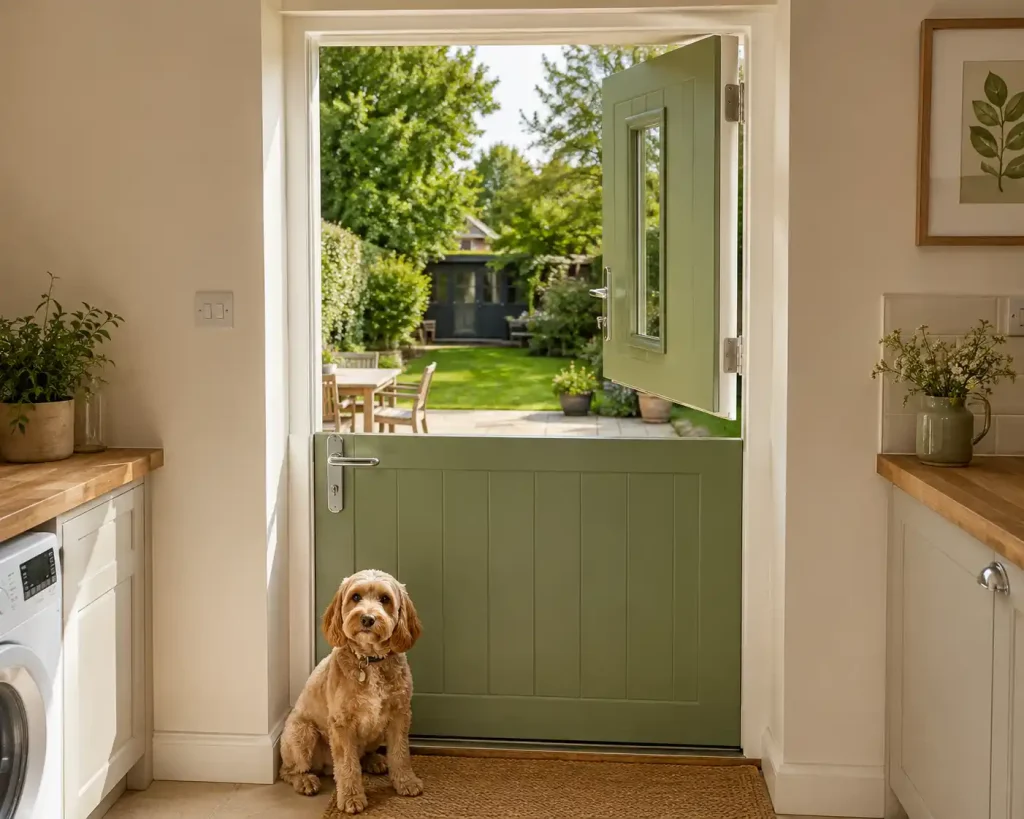
A composite stable door divides horizontally across the middle, allowing the upper and lower sections to be opened independently of each other. The upper half can be opened for ventilation and natural light while the lower half remains closed and locked, or both sections can be opened and closed together as a standard door when needed.
Stable doors were originally designed for agricultural use, but they have become increasingly popular as residential back doors, side access doors, and kitchen entrance doors across Enfield and the wider North London area. Their practical advantages make them particularly well suited to certain household situations.
Who stable doors suit
Households with young children benefit from the lower half remaining closed and locked while the upper half is open, preventing children from wandering into a garden or outdoor area unsupervised while still allowing airflow and visibility into the garden. The same applies for households with dogs or cats where containing a pet while ventilating the kitchen or utility room is a daily practical requirement.
Properties with a kitchen or utility room opening directly onto a rear garden or patio are the most natural fit for a stable door, as the split opening allows fresh air and natural light into the room without fully opening the rear of the house. This is particularly useful in summer when a fully open back door may feel exposed or create a security concern.
Specification and security
Composite stable doors are available in the same materials, colours, and hardware options as standard composite doors. The upper and lower sections each have their own locking points, and when both halves are closed the combined locking mechanism provides the same level of security as a standard composite door.
The construction uses the same 44mm GRP outer skin, polyurethane foam core, and hardwood inner frame as the rest of our composite door range, so there is no compromise on insulation or structural integrity compared to a standard door.
Popular colour choices for composite stable doors on Enfield residential properties include chartwell green, cream, duck egg blue, and anthracite grey, all of which work well on rear elevations where a slightly more relaxed and characterful appearance is appropriate compared to the principal street-facing facade.
Where we install composite stable doors in Enfield
We regularly install composite stable doors on rear and side access points across Enfield, particularly on semi-detached and detached properties in Palmers Green, Winchmore Hill, Southgate, and Grange Park where rear garden access from a kitchen or utility room is a common layout.
If you are considering a stable door for your property, a site visit allows us to assess the existing opening and advise on the most suitable specification. If you are also looking to open up the rear of your home more fully, our bi-fold doors Enfield page covers the full range of aluminium and uPVC bi-fold door options across the borough.
Cost guide, composite doors Enfield
The cost of a composite door in Enfield depends on the door size, style, glazing specification, colour, hardware choices, and cylinder grade.
The prices below are intended as a general guide to help you budget before requesting a quote. As with all made-to-measure installations, the most accurate price comes from a site survey where the existing opening, frame condition, and specification requirements can be properly assessed.
Composite front doors, Enfield
- Standard composite front door, supply and install, £1,200 to £1,800
- Composite front door with side panels, supply and install, £1,600 to £2,400
- Composite front door with full frame replacement, supply and install, £1,400 to £2,000
Supply only options are available, typically 35 to 45 percent less than the supply and install figures above.
Composite back doors, Enfield
- Standard composite back door, supply and install, £1,000 to £1,500
- Composite back door with glazed panel, supply and install, £1,100 to £1,600
Supply only options are available on composite back doors for customers who prefer to arrange their own installation.
Composite stable doors, Enfield
- Composite stable door, supply and install, £1,300 to £1,900
- Composite stable door with glazed upper panel, supply and install, £1,400 to £2,000
Supply only options are available on composite stable doors if required.
What affects the cost?
Several factors influence the final price beyond the base door specification,
Door size and configuration
standard door sizes are the most cost effective option. Non-standard sizes, oversized openings, and doors with side panels or full frame replacements require more material and more involved installation, both of which affect the final price.
Glazing specification
Standard toughened safety glass is included in the base price ranges above. Laminated glass, decorative leaded glass, and sealed unit energy-efficient glazing upgrades add to the cost depending on the size and number of glazed panels.
Colour and finish
Standard colours including white, cream, and anthracite grey are included in the base price ranges. Less common colours, dual colour specifications where the inside and outside are finished differently, and woodgrain foils may add a modest premium to the door cost.
Hardware grade
Standard lever handles and letter plates in chrome or black are included in the base price. Upgraded hardware suites, long bar contemporary handles, pull escutcheons, and matching door knockers and numerals add to the cost depending on the specification chosen.
Cylinder grade
A standard cylinder is included in the base price. Anti-snap, anti-pick, and anti-drill 3 star TS007 cylinders are available as an upgrade and add a modest amount to the overall cost. Given the security benefit, we recommend specifying a 3 star cylinder on all front door installations as a matter of course.
Frame condition
Where the existing door frame is in poor condition and requires repair or full replacement before the new door can be fitted, this adds to the overall installation cost. A site survey will identify any frame condition issues before a quote is provided.
Getting an accurate quote
The figures above give a useful starting point, but the most reliable way to get an accurate price is through a site survey at your property. This allows us to assess the existing opening, examine the frame condition, take precise measurements, and recommend the most appropriate specification for your property and budget.
We carry out surveys across all Enfield postcodes, EN1, EN2, and EN3, as well as surrounding areas including Barnet, Southgate, Palmers Green, Edmonton, and Tottenham. All quotes are free and provided without any obligation to proceed.
Installation process
Replacing a composite door is one of the more straightforward home improvement installations we carry out, and in most cases the entire process from removal of the old door to final inspection is completed within a single day. Here is what to expect when you choose Urgent Windows for your composite door installation in Enfield.
Step 1, initial consultation
The process begins with a conversation about your requirements. We will discuss the door position, front, back, or side access, the style and colour options that suit your property, hardware preferences, and any specific considerations such as non-standard opening sizes or frame condition concerns. This can be done over the phone, via WhatsApp, or in person during a site visit.
Step 2, survey and measurement
We carry out a site survey at your property, taking precise measurements of the existing opening and assessing the condition of the existing frame and threshold.
Where the existing frame is in poor condition and requires repair or replacement, we will identify this at the survey stage and include it in the quote rather than discovering it on installation day.
We carry out surveys across all Enfield postcodes, EN1, EN2, and EN3, and can usually arrange a visit within a few days of your initial enquiry.
Step 3, product selection and quote
Following the survey, we provide a clear itemised quote covering the door specified during the consultation. We will confirm the door style, colour, glazing specification, hardware suite, and cylinder grade, and answer any remaining questions before you make a decision. There is no obligation to proceed and no pressure to decide on the day.
Step 4, manufacture and scheduling
Once you are happy to proceed, your door is ordered to the precise measurements taken during the survey. Made-to-measure composite doors typically take two to three weeks to manufacture depending on the colour and specification. We will confirm the installation date in advance and keep you informed throughout.
Step 5, installation
Our own installation team carries out all work, we do not use subcontractors. A standard single composite door installation is typically completed within three to four hours, meaning most front or back door replacements are done within a single morning or afternoon visit.
The process involves carefully removing the existing door and frame where required, preparing the opening, fitting the new door to the precise measurements taken during the survey, adjusting the hinges and locking points for smooth and secure operation, and finishing the internal and external reveals neatly. We remove and dispose of the old door as part of the installation.
Step 6, final inspection and handover
On completion we carry out a full check of the door, testing the locking mechanism at all points, confirming the door closes and seals correctly, and checking the operation of all hardware.
We demonstrate the locking system to you and confirm the cylinder key operation before we leave. We then issue your FENSA certificate confirming that the installation complies with current building regulations, along with documentation for your workmanship and product guarantees.
Credentials and guarantees
When you invite a company into your home to replace your front door, the credentials and guarantees they offer matter as much as the product itself. Here is what Urgent Windows provides on every composite door installation in Enfield.
FENSA registration
Urgent Windows is FENSA registered, meaning every composite door installation we carry out in Enfield is self-certified as compliant with current building regulations, including thermal performance and safety glazing requirements.
You receive a FENSA certificate on completion of every installation, which is an important document if you come to sell your property, as solicitors routinely request it as evidence of compliant installation work.
FENSA registration also means our work is independently monitored for quality and compliance, providing an additional layer of assurance beyond our own standards.
Insurance-backed guarantee
Every composite door installation we carry out is backed by an insurance-backed guarantee. This means that in the unlikely event that Urgent Windows ceases to trade during the guarantee period, your guarantee remains valid and is honoured by an independent insurer.
This provides long-term protection for your investment regardless of what happens to the installing company, and is particularly important for a product like a composite door that is expected to last 35 years or more.
Workmanship guarantee
In addition to the insurance-backed guarantee, every installation is covered by our own workmanship guarantee. If any issue arises directly from the installation rather than the product itself, we will return to resolve it. This is separate from the manufacturer’s product guarantee that covers the door leaf, frame, and hardware against manufacturing defects.
ABI compliant locking systems
Every composite door we install uses locking systems that comply with the requirements of the Association of British Insurers. This is a practical requirement rather than a marketing point, a door lock that does not meet ABI standards may invalidate a home insurance claim following a break-in, regardless of how the door itself performed. Specifying ABI compliant hardware on every installation protects you against this risk as standard.
In-house installation team
We do not use subcontractors. Every composite door installation in Enfield is carried out by our own employed installation team, which means consistent quality, direct accountability, and a single point of contact if anything needs attention after installation. When you book with Urgent Windows, you know exactly who is coming to your property.
Why choose a local Enfield installer?
Composite doors are widely available from national manufacturers, online suppliers, and large double glazing chains. The question most homeowners in Enfield face is not where to find a composite door but who to trust to install it properly and stand behind the work afterwards.
Choosing a local installer makes a practical difference in ways that become apparent both during the process and long after installation day.
You know who is coming to your property
National manufacturers like Endurance supply doors through networks of installer partners. When you use this route, the manufacturer takes your enquiry and passes it to a local installer from their network, who may or may not have specific experience with Enfield properties and whose quality standards you have no direct way to assess before they arrive.
When you book with Urgent Windows, our own team carries out the installation, the same people who surveyed your property and agreed the specification with you. There are no subcontractors and no uncertainty about who will be at your door on installation day.
Local knowledge of Enfield property types
Composite door installations in Enfield involve a wide variety of property types, Victorian and Edwardian terraces in Bush Hill Park and Enfield Town with original brick reveals and non-standard opening sizes, interwar semis in Palmers Green and Winchmore Hill with timber sub-frames in varying conditions, purpose-built flats in Edmonton and Tottenham with communal entrance considerations, and modern builds in Grange Park and Crews Hill with standard opening sizes but specific threshold requirements.
A local installer who works regularly across these property types understands the practical differences between them and approaches each job with the right materials and method from the outset.
Faster surveys and response times
Being based in Enfield means we can arrange surveys and installations more quickly than a company operating nationally or from a distant depot. There are no lengthy waiting lists for a local visit, and if anything needs attention after installation, we are nearby, easy to reach, and motivated to resolve it quickly.
For landlords managing rental properties across Enfield who need a front or back door replaced promptly between tenancies, this local responsiveness is particularly valuable.
Accountability that is genuinely local
A local company has a reputation to maintain in the specific streets and neighbourhoods it serves. Recommendations from neighbours, local letting agents, and previous customers in the same area are a significant source of our work in Enfield, which means our incentive to do the job properly and support you afterwards is direct and genuine rather than transactional.
If something needs attention after your door is installed, we are not a call centre or a distant head office, we are a local business that cares about its standing in the community it works in.
Frequently asked questions
Get a free quote
If you are considering a new composite front door, back door, or stable door for your property in Enfield, we are happy to help you find the right door for your home.
Whether you have a clear specification in mind or are still deciding between styles, colours, and hardware options, our team can advise on the most appropriate choice for your property type, discuss the security features and certifications that matter for your situation, and provide a free no-obligation quote following a site survey at your property.
We cover all Enfield postcodes, EN1, EN2, and EN3, as well as surrounding areas including Barnet, Southgate, Palmers Green, Winchmore Hill, Bush Hill Park, Edmonton, and Tottenham. Surveys can usually be arranged within a few days of your initial enquiry.
Get in touch via the form below, by phone, or on WhatsApp, and we will get back to you promptly.