
Bi-Fold Doors Enfield – Supply & Installation
Bi-fold doors are one of the most transformative home improvements available. When the panels fold back, the entire rear wall of a room opens up, connecting the interior directly to the garden, flooding the space with natural light, and changing how the property feels to live in day to day.
At Urgent Windows, we supply and install bi-fold doors across Enfield, covering EN1, EN2, and EN3. We install aluminium bi-fold doors as our primary product, offering the slimline frames, large glass panels, and flexible configurations that make bi-fold doors the standout choice for rear extensions, kitchen renovations, and garden room connections across Bush Hill Park, Palmers Green, Edmonton, Southgate, and the wider Enfield area.
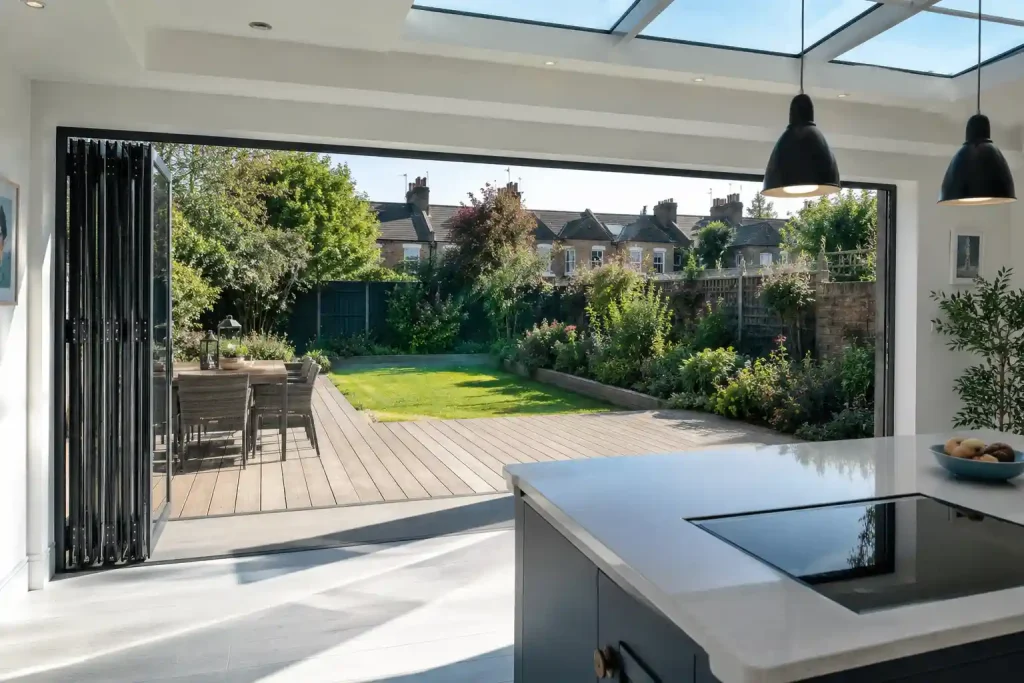
uPVC bi-fold doors are also available for homeowners where budget is the primary consideration and the aperture is smaller. We are happy to advise on the most appropriate material for your specific opening during a free consultation.
Every bi-fold door we install is made to measure, fitted by our own team, and backed by a full workmanship guarantee and FENSA certification.
What are bi-fold doors?
Bi-fold doors are a multi-panel door system where the individual panels fold back on themselves in a concertina action, stacking neatly to one side or both sides of the opening when fully open.
Unlike a standard door that swings open into the room, or a sliding door that moves along a track, bi-fold doors fold completely out of the way to create an unobstructed opening across the full width of the aperture.
The panels are hung from an overhead track and run on rollers along a bottom guide rail, allowing the entire door system to move smoothly and quietly regardless of the number of panels or the width of the opening.
A single bi-fold door system can span apertures from around 1.2 metres for a two panel configuration up to 10 metres or more for larger openings across the full rear wall of an extension.
The traffic door
Most bi-fold door configurations include a traffic door, a single panel within the overall system that opens independently like a standard door without folding the rest of the panels.
This is the panel used for everyday access in and out of the garden, allowing you to step through without opening the full bi-fold system every time.
The traffic door can be positioned at either end of the configuration or in the centre depending on the layout of the opening and the access pattern of the household.
Where bi-fold doors are most commonly installed in Enfield
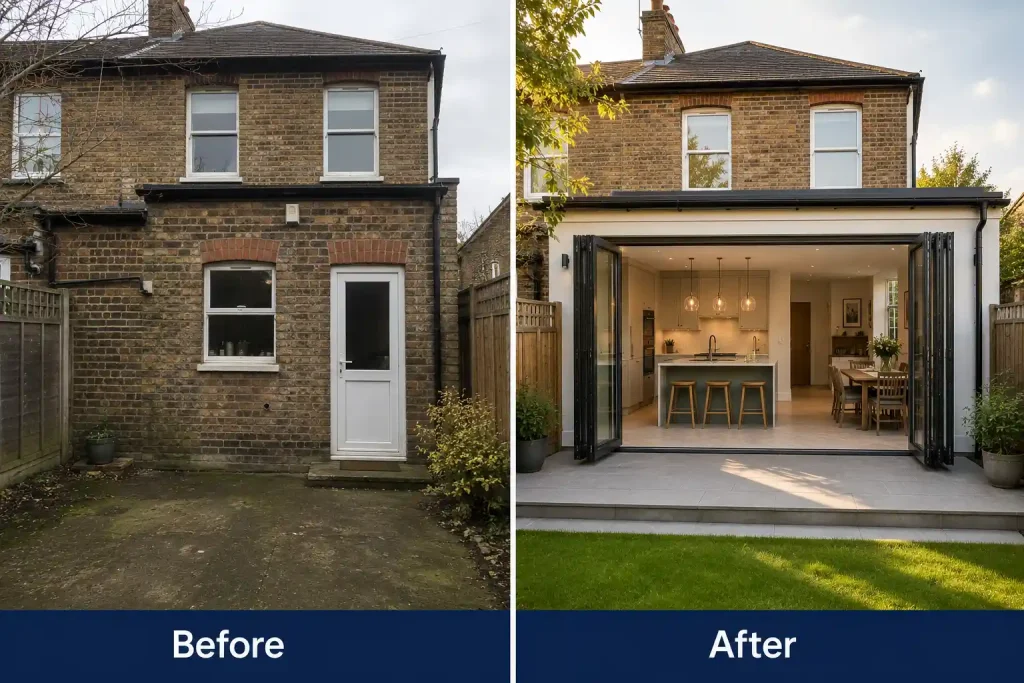
Bi-fold doors are almost always installed as part of a home improvement project rather than as a like-for-like replacement. The most common scenarios across Enfield are single storey rear extensions on Victorian and Edwardian semis where the new extension opens onto the garden, kitchen renovations where the existing rear wall is opened up to create a connection with outdoor dining or entertaining space, and rear living room upgrades where replacing an existing patio door with a full-width bi-fold system dramatically increases light and access to the garden.
Transforming your Enfield home
The difference a set of bi-fold doors makes to the rear of a property is difficult to overstate. A kitchen or living room that previously looked out onto the garden through a standard patio door or a pair of French doors is fundamentally changed when the entire rear wall opens up. The room feels larger, lighter, and more connected to the outdoor space in a way that no other door system achieves.
Kitchen extensions and rear renovations
The most common bi-fold door installation across Enfield is in a kitchen extension or rear renovation where the new extension opens directly onto the garden. Victorian and Edwardian semis in Bush Hill Park, Palmers Green, and Winchmore Hill typically have rear gardens that receive good afternoon and evening sun, and a full-width bi-fold door system across the back of a kitchen extension allows that light and the outdoor connection to be fully exploited rather than partially blocked by a door frame.
For kitchens that open onto a patio or decking area, the bi-fold doors create a seamless indoor-outdoor entertaining space in warmer months, with the full width of the opening available for movement between the kitchen and the garden.
When the doors are closed in winter, the large glazed panels maintain the connection with the outdoor space and allow natural light to penetrate further into the room than a standard door or window arrangement.
Rear living rooms and garden rooms
Properties across Edmonton, Grange Park, and the newer residential developments in Enfield increasingly use bi-fold doors to connect ground floor living rooms and garden rooms to the rear outdoor space.
In these properties, replacing an existing sliding patio door or standard French doors with a wider bi-fold configuration dramatically increases both the light entering the room and the sense of space, particularly in rooms that face north or northeast and benefit most from maximising the available glass area.
Adding value to your property
Bi-fold doors are consistently cited as one of the home improvements that adds measurable value to a residential property. In the Enfield property market, where competition between similar Victorian and Edwardian semis and period properties is strong, a well-specified rear extension with quality aluminium bi-fold doors is a visible and desirable feature that distinguishes a property from comparable homes on the same street.
Panel configurations and opening options
One of the most important decisions when specifying bi-fold doors is choosing the right panel configuration for your opening. The number of panels, the fold direction, and whether a traffic door is included all affect how the doors look when closed, how they operate day to day, and how much of the opening is cleared when the panels are fully folded back.
Number of panels
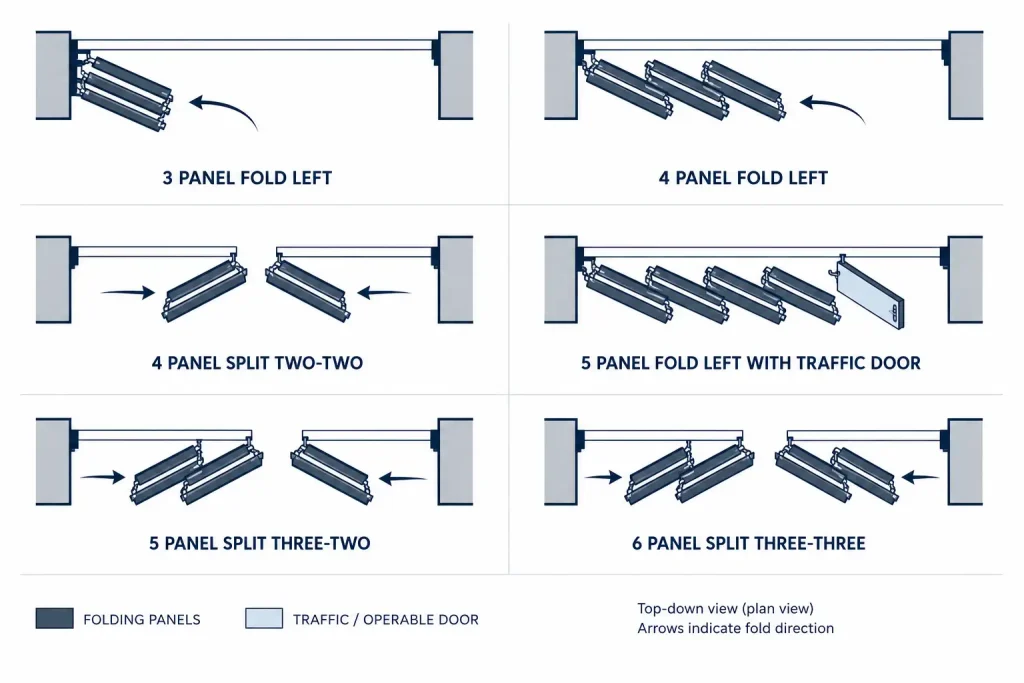
Bi-fold doors are available in configurations from two panels up to eight or more for very large apertures. As a general guide, Two or three panels suit narrower openings from 1.2 to 2.4 metres, typically used for single doorway access points or smaller kitchen openings where a full-width fold-back is not required.
Three or four panels are the most common configuration for standard rear extensions in Enfield, typically covering apertures from 2.4 to 3.6 metres. A four panel system provides a good balance between the number of panels and the width of the clear opening when fully folded.
Five or six panels suit wider apertures from 3.6 to 6 metres, commonly used on larger kitchen extensions, open-plan living spaces, and properties where the full rear wall of the extension is glazed. These configurations provide a dramatic opening and maximise the connection between interior and exterior.
Seven or eight panels are specified for very wide apertures above 6 metres, typically on larger renovation projects, commercial applications, and properties where the full rear elevation is designed around the bi-fold door system.
Fold direction
Panels can fold to the left, to the right, or split and fold in both directions from the centre. The fold direction determines where the stacked panels sit when the doors are open, and should be chosen to suit the layout of the room and garden rather than defaulting to a standard configuration. If one side of the opening has more clearance than the other, folding all panels to the wider side creates a cleaner and more usable open space.
Traffic door position
The traffic door can be positioned at either end of the configuration or, in some systems, in the centre of the run. End-positioned traffic doors are the most common and suit most residential layouts.
A central traffic door is more appropriate for wider configurations where walking to the end of the opening for everyday access would feel inconvenient.
Internal vs external fold
Bi-fold panels can be configured to fold internally, stacking inside the room when open, or externally, stacking outside the building. Internal fold is the more common choice for residential installations and keeps the external facade clean when the doors are open.
External fold maximises the usable floor space inside the room but requires sufficient clearance outside the building for the stacked panels, which may not be available on all properties.
Configurations for common Enfield property types
For a typical Victorian or Edwardian semi in Bush Hill Park or Palmers Green with a single storey rear extension of 3 to 4 metres width, a four panel configuration folding to one side with a traffic door at the garden end is the most practical and widely specified choice.
For larger extensions on detached properties in Grange Park or Crews Hill, a five or six panel configuration split folding from the centre provides the most dramatic opening and the best balance of access from either side of the space.
Slimline sightlines and natural light
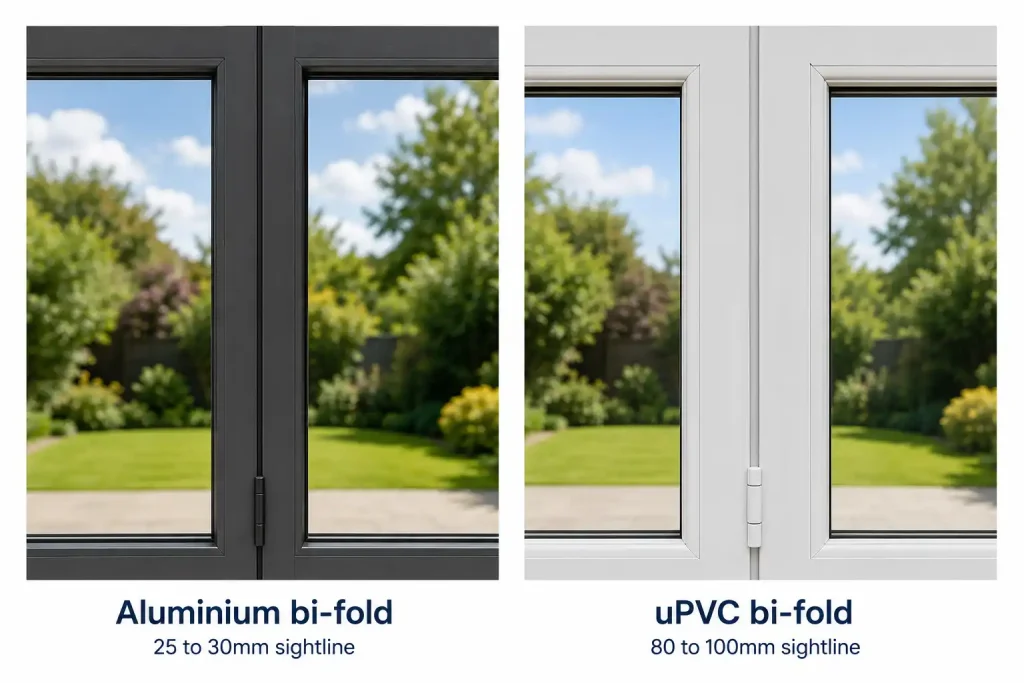
The sightline of a bi-fold door is the width of the frame visible between the glass panels when the doors are closed. On older patio door systems and standard uPVC bi-fold doors, sightlines can be 100mm or wider, meaning a significant portion of the view through the door is occupied by frame rather than glass.
On modern aluminium bi-fold doors, sightlines of 20 to 35mm per panel junction are achievable, which dramatically increases the glass area and the quality of the view through the door when closed.
Why slim sightlines matter
The practical effect of slim sightlines goes beyond aesthetics. A wider glass area means more natural light enters the room throughout the day, which is particularly significant for rear-facing rooms in Enfield’s Victorian and Edwardian terraces that can feel dark during winter months.
The unobstructed view through large glass panels also maintains the visual connection with the garden when the doors are closed, which is much of the appeal of bi-fold doors during the months when opening them fully is not practical.
Aluminium makes slim sightlines possible
Aluminium is inherently stronger than uPVC, which means the same structural performance can be achieved with a significantly narrower frame section. This is the primary reason aluminium is the dominant material for bi-fold doors, the slim frames that define the modern bi-fold aesthetic simply cannot be replicated in uPVC without compromising either the structural integrity of the frame or the size of the glass panels it can support.
For properties in Enfield where the rear garden or outdoor space is the primary view from the main living area, maximising the glass area through slim sightlines has a direct and noticeable impact on how the room feels throughout the year, not just on the days when the doors are opened fully.
Maximising natural light in north-facing rooms
Many Victorian and Edwardian terraces across Enfield Town, Bush Hill Park, and the surrounding streets have rear rooms that face north or northeast, receiving limited direct sunlight particularly in autumn and winter.
A full-width bi-fold door system with slim aluminium sightlines maximises the available daylight entering these rooms, making them feel significantly brighter and more usable throughout the year than a standard patio door or French door arrangement allows.
Thermal performance
A common concern about bi-fold doors is whether a large expanse of glazing across the rear of a room will make the space cold in winter. Modern aluminium bi-fold doors are engineered to address this concern directly, and the thermal performance of a well-specified bi-fold system is significantly better than older patio door installations they typically replace.
Thermal break technology
The key to thermal performance in aluminium bi-fold doors is the thermal break, a continuous strip of non-conductive polyamide material built into the aluminium frame between the inner and outer sections.
Aluminium conducts heat readily, and without a thermal break the frame would transfer warmth from inside the room to the cold external face of the door, creating a significant source of heat loss.
The thermal break interrupts this transfer, allowing the aluminium frame to achieve insulation performance comparable to uPVC despite the inherently higher conductivity of the metal.
U-value performance
Modern aluminium bi-fold doors achieve whole door U-values of up to 1.5 W/m²K with standard double glazing, and lower with triple glazing.
For context, an older aluminium patio door without a thermal break may have a U-value of 5.0 W/m²K or higher, meaning modern thermally broken bi-fold doors lose heat at a fraction of the rate of the systems they commonly replace.
All our bi-fold door installations comply with the requirements of Approved Document L of the Building Regulations, which sets the minimum thermal performance standard for replacement doors and windows in England.
Double or triple glazing
Double glazing with argon gas filling and low-emissivity glass is the standard specification for aluminium bi-fold doors and suits the majority of residential installations in Enfield well.
Triple glazing reduces heat loss further and improves acoustic performance, which may be worth specifying for properties on busy roads, near the A10 or A1010, or for rooms where maximum thermal performance is a priority.
Weather seals and low threshold
The weather performance of a bi-fold door system depends as much on the quality of the seals and threshold as on the glazing specification. Our bi-fold doors use compression weather seals around every panel junction and frame perimeter, maintaining a weathertight barrier when the doors are closed.
Low threshold options are available for level or near-level access between the interior floor and the external patio or decking, which also reduces the thermal bridge at the base of the door opening.
Security
Bi-fold doors cover large openings and the question of how secure they are is a reasonable one. Modern aluminium bi-fold door systems are significantly more secure than older patio door installations and incorporate multiple security features specifically designed to resist forced entry across a wide glazed aperture.
Multi-point and six-point locking
Our aluminium bi-fold doors feature multi-point locking systems that engage at multiple points along the height of each panel when the doors are locked. Many systems use a six-point locking mechanism on the main traffic door, engaging at the top, bottom, and at four intermediate points along the door height, distributing resistance across the full panel rather than concentrating it at a single latch point. This makes forced entry by kicking or levering significantly more difficult than on a standard single-point lock.
PAS24 security standard
Our bi-fold door systems meet the requirements of PAS24, the British Standard for enhanced security performance in doors and windows. PAS24 certification requires the door system to pass a series of independently tested forced entry scenarios across the full configuration including the traffic door, fixed panels, and the junction between panels. Meeting this standard provides independent verification that the complete door system rather than just the locking hardware performs to a recognised security benchmark.
Internal glazing bead
The glazing panels in our bi-fold doors are secured from the inside using an internal glazing bead, meaning the glass cannot be removed from the exterior by an intruder. This addresses a common vulnerability in older glazed door systems where externally fitted beads allowed the glass to be pushed out without engaging the locking mechanism.
Finger-safe gaskets
Finger-safe gaskets are fitted at every panel junction to prevent fingers from being trapped in the folding mechanism as the panels close. This is a practical safety feature particularly important for households with young children, and is standard on all our bi-fold door installations rather than an optional upgrade.
Solid aluminium carriages and stainless steel rollers
The running gear of a bi-fold door system, the carriages that hang the panels from the overhead track and the rollers that guide the bottom rail, directly affects the long-term security and smooth operation of the doors.
Our installations use solid aluminium carriages and stainless steel rollers that maintain their dimensional stability and smooth operation over the lifetime of the door, ensuring the panels continue to close and lock correctly rather than sagging or misaligning over time.
Aluminium vs uPVC bi-fold doors
For bi-fold doors specifically, aluminium is the better material choice for most homeowners in Enfield. This is a stronger recommendation than we make for windows, where uPVC is a genuinely competitive alternative for the majority of residential installations. For bi-fold doors the case for aluminium is more clear-cut, and understanding why helps you make a more informed decision.
Why aluminium is the better choice for bi-fold doors
Slim sightlines are only achievable in aluminium. The structural strength of aluminium allows frames of 20 to 35mm between panels, maximising the glass area and the quality of the view. uPVC frames require considerably more material to achieve the same structural performance, resulting in sightlines of 80 to 100mm or wider that occupy a noticeable portion of the opening and reduce both the visual impact and the natural light entering the room.
Larger glass panels are possible with aluminium. Because aluminium is stronger, it can support larger individual glass panes without requiring additional frame members across the opening. This reduces the number of vertical sightlines across the aperture and increases the overall glazed area of the door system.
Longer lifespan. Aluminium bi-fold doors have an expected lifespan of 35 to 40 years or more with basic maintenance. uPVC bi-fold doors typically last 20 to 25 years before the frames begin to discolour and the seal and hardware performance deteriorates. For a product that is usually installed as part of a significant extension or renovation project, the longer aluminium lifespan represents better long-term value despite the higher upfront cost.
Greater configuration flexibility. Aluminium can accommodate a wider range of panel configurations, larger apertures, and more complex arrangements such as corner bi-fold systems than uPVC, giving you more freedom to design the opening around your specific space rather than working within the limitations of the material.
When uPVC bi-fold doors are worth considering
uPVC bi-fold doors are a reasonable option for narrower apertures of two to three panels where the sightline difference between aluminium and uPVC is less pronounced, and for installations where budget is the primary consideration and the visual impact of slim sightlines is less important. For a two or three panel bi-fold on a smaller kitchen opening where cost matters more than maximum glass area, uPVC provides adequate performance at a lower upfront cost.
We supply and install both aluminium and uPVC bi-fold doors and are happy to advise on the most appropriate choice for your specific opening, budget, and priorities during a free consultation, without any pressure toward the higher-cost option.
Colours and customisation
Aluminium bi-fold doors are available in an extensive range of colours and finishes, making it straightforward to specify a door system that works with the architectural character of your property and the design of your extension or renovation.
Colour options
Aluminium bi-fold doors are powder-coated in a wide range of colours from the RAL colour palette, which includes over 200 standard shades as well as custom colour matching for specific requirements. The most widely specified colours for Enfield residential properties are,
Anthracite grey, the most popular choice for contemporary extensions and rear renovations across Enfield. Works well on both modern builds and period properties where a bold contrast against brick is desired. Creates a clean, sharp visual boundary between the interior and the garden that reads as distinctly contemporary from both inside and outside the property.
Black, a stronger and deeper alternative to anthracite grey that suits properties with lighter rendered facades or those where a more dramatic visual statement is preferred. Increasingly specified on larger aperture bi-fold installations where the door system itself is a significant design feature of the extension.
White, the most neutral choice and the most versatile across different property styles. Works particularly well where the bi-fold doors need to complement existing white or cream window frames on the same elevation, maintaining a consistent colour palette across the rear of the property.
Anthracite grey inside and white outside, or white inside and anthracite grey outside, a popular dual colour specification that allows the exterior colour to suit the facade while the interior colour complements the room decoration. Dual colour frames are available on aluminium bi-fold systems and add a modest premium to the overall cost.
Woodgrain finishes, available in oak, golden oak, and similar timber-effect foils applied over the powder-coated aluminium frame, for homeowners who want the warmth of a timber appearance from inside the room while maintaining the structural and maintenance advantages of aluminium.
Hardware and accessories
Handles on aluminium bi-fold doors are typically contemporary in style, slim and recessed to complement the minimal aesthetic of the slimline frame. Available in chrome, brushed steel, graphite, and black finishes to match the colour of the frame or contrast with it. Flush pull handles on fixed panels maintain the clean external line of the door system when viewed from the garden.
Locking handles on the traffic door operate the multi-point locking mechanism and are available in the same finish options as the rest of the hardware suite. Matching hardware across the full door system, handles, hinges, and locking points in the same finish, gives the installation a cohesive and considered appearance that cheaper systems with mixed hardware finishes do not achieve.
Bi-fold vs sliding vs French doors, which should you choose?
If you are opening up the rear of your property and weighing up your options, the choice between bi-fold doors, sliding doors, and French doors comes down to the width of your opening, how much of it you want to clear when the doors are fully open, and the visual character you want to achieve. Each system has genuine advantages and the right choice depends on your specific situation rather than a single universal recommendation.
Bi-fold doors
Bi-fold doors are the right choice when you want the maximum possible opening across a wide aperture. When fully folded, the panels stack neatly to one or both sides, clearing close to 90 percent of the total opening width and creating an unobstructed connection between the interior and the garden. This makes bi-fold doors the best option for wide rear extensions of 3 metres or more where the full indoor-outdoor opening experience is the primary goal.
The trade-off is that the folded panels require floor space at the side of the opening when stacked, and the folding mechanism adds more moving parts than a sliding system. For very wide apertures with multiple panels, opening and closing the full bi-fold system takes slightly more effort than operating a single sliding door panel.
Sliding doors
Sliding doors are the better choice when floor space is limited or the aperture is narrower. The panels slide along tracks and park behind each other rather than folding outward, meaning there is no intrusion into the room or the garden when the doors are open. Sliding doors also offer slimmer sightlines across the full closed aperture than bi-fold doors in some configurations, as there are fewer panel junctions across the opening.
The trade-off is that a standard two panel sliding door can only clear half the opening width at most, as one panel always sits behind the other. For homeowners who want a completely clear opening, bi-fold doors are the more appropriate choice.
French doors
French doors are the right choice for narrower openings of up to around 1.8 metres where the primary requirement is garden access rather than a full-width open connection. Two panels opening outward provide a generous access point and a traditional appearance that suits period properties particularly well. French doors are also lower in cost than bi-fold or sliding systems of equivalent quality, making them a cost-effective choice for smaller openings where the bi-fold format is not required.
The trade-off is that French doors clear only the width of the two panels when open and cannot span the wider apertures that bi-fold and sliding systems accommodate. For a wide rear extension where the open indoor-outdoor connection is a priority, French doors are a less satisfying solution.
A simple decision guide
Wide aperture of 2.4 metres or more and you want the maximum open connection with the garden, choose bi-fold doors. Narrower aperture or limited floor space at the sides of the opening, choose sliding doors.
Traditional property with a narrower opening and cost is a consideration, choose French doors. Unsure which suits your specific opening, a site visit allows us to assess the space and advise on the most appropriate system before any commitment is made.
Corner bi-fold doors
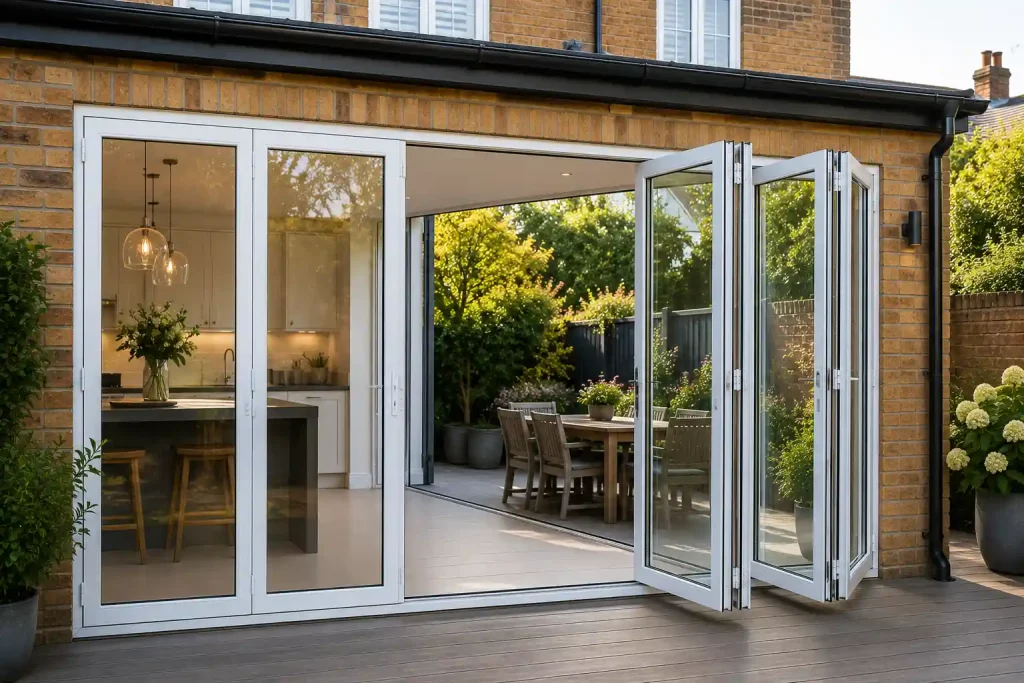
Corner bi-fold doors are a specialist configuration where two sets of bi-fold panels meet at a corner of the building with no corner post between them. When both sets are fully open, the entire corner of the room is cleared, creating an opening that wraps around two walls simultaneously and connects the interior to the garden or outdoor space on two sides at once.
How corner bi-fold doors work
Standard bi-fold door installations require a structural post at each end of the aperture to support the building above the opening. In a corner bi-fold configuration, the two sets of doors meet at a specially engineered corner bracket that allows both door systems to fold back independently without a fixed post occupying the corner junction.
This requires careful structural planning to ensure the loads above the corner opening are properly transferred to the surrounding structure, and is typically specified at the design stage of a new extension rather than retrofitted to an existing corner.
When corner bi-fold doors work best
Corner bi-fold doors are most appropriate for L-shaped extensions where two elevations of the new build both face the garden, for open-plan kitchen and dining room configurations where the room wraps around a corner and connects to an outdoor entertaining area on two sides, and for properties where the garden wraps around the rear corner of the house and access from multiple directions is a practical benefit.
Across Enfield, corner bi-fold door installations are most commonly seen on larger detached properties in Grange Park, Crews Hill, and the wider EN2 area, where the garden size and extension footprint make the fully open corner configuration a genuine lifestyle benefit rather than an architectural flourish.
Cost and planning considerations
Corner bi-fold doors are a premium product and are priced accordingly. The structural engineering required to eliminate the corner post, the specialist corner bracket system, and the increased manufacturing complexity all add to the overall cost compared to a standard bi-fold configuration.
A site survey and structural assessment are essential before specifying a corner bi-fold system, as the feasibility depends on the structural conditions of the specific building.
If you are planning an extension and considering corner bi-fold doors, raising this at the earliest stage of the project with both your architect and our installation team allows the structural requirements to be incorporated into the design from the outset rather than addressed retrospectively.
Bi-fold doors with integral blinds
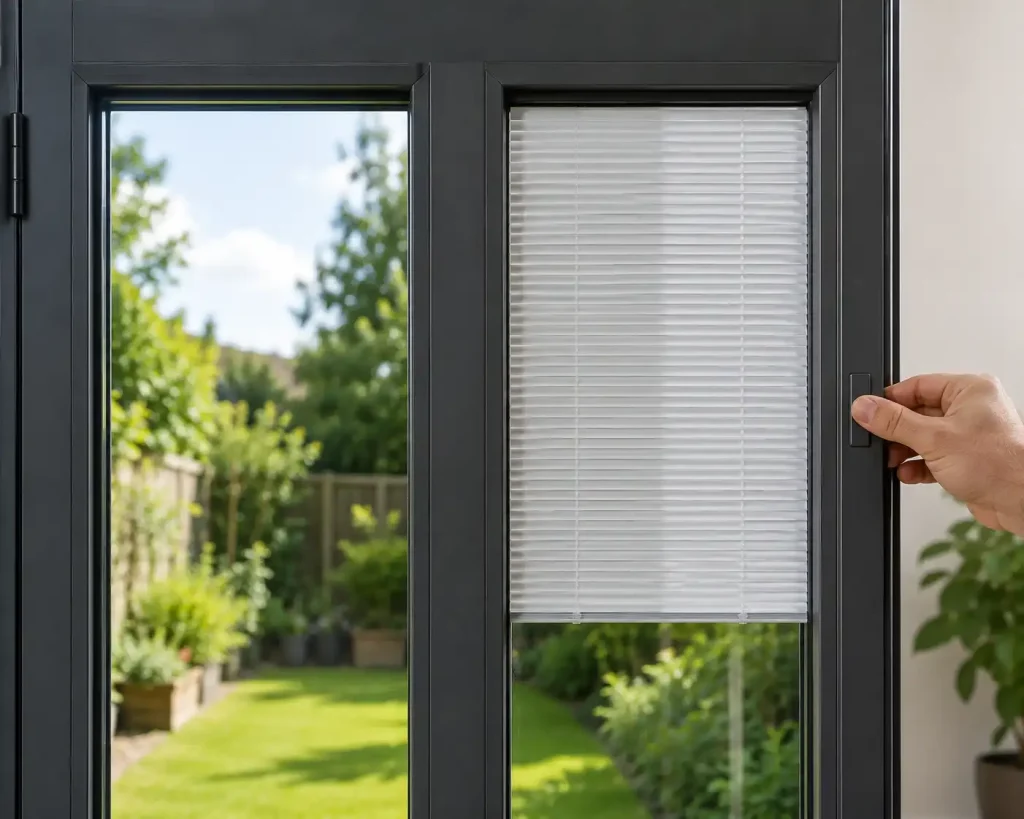
Integral blinds are a glazing option where the blind is sealed within the double-glazed unit itself, sitting in the air gap between the two panes of glass rather than being mounted as a separate fitting on the inside or outside of the door. They are operated by a small magnetic slider on the edge of the glazing unit that moves the blind up, down, or to a tilted position without any physical connection through the glass.
Why integral blinds suit bi-fold doors particularly well
Standard roller blinds, venetian blinds, or curtain tracks mounted alongside bi-fold doors create a practical problem, they interfere with the folding mechanism when the doors are opened, either needing to be raised fully before the doors can be operated or becoming damaged over time through repeated contact with the folding panels. Integral blinds eliminate this problem entirely because they are contained within the glass unit and move with the door panel rather than remaining fixed to the wall or ceiling when the doors open.
This makes integral blinds the most practical privacy and solar control solution for bi-fold doors, particularly for south or west-facing rear elevations in Enfield where afternoon and evening sun can make a glazed rear room uncomfortably warm or create glare on screens and televisions during certain times of day.
What integral blinds offer
Privacy control without external fittings, the blind is invisible from outside when raised and provides complete privacy when lowered, with no visible mechanism on the inside or outside of the door frame. Solar control that reduces heat gain through the glass on sunny days, which helps maintain comfortable room temperatures in summer without relying on air conditioning or fans. Easy operation from a single magnetic slider that requires no drilling, no wiring, and no maintenance beyond occasional cleaning of the glass surface. Dust-free performance because the blind is sealed within the unit and cannot accumulate dust, pollen, or pet hair as a standard blind does.
Availability and cost
Integral blinds are available as an upgrade on double-glazed bi-fold door panels and add a moderate cost per panel to the overall installation price. They are available in white, cream, and anthracite grey to complement the frame colour, and in varying opacity levels from translucent to fully opaque depending on the privacy and light control required.
Low maintenance
Aluminium bi-fold doors require very little ongoing attention once installed, which is one of the practical advantages of aluminium over timber alternatives for large glazed openings.
Frame maintenance
The powder-coated finish on aluminium bi-fold frames is highly resistant to fading, chipping, and corrosion, and retains its colour and appearance reliably over the 35 to 40 year lifespan of the door system.
Unlike timber bi-fold doors, which require periodic repainting, re-sealing, and treatment against moisture and fungal damage, aluminium frames need nothing more than an occasional wipe-down with a damp cloth and mild detergent to keep them looking as they did on installation day.
The colour does not fade or chalk over time as painted surfaces can, and minor surface marks clean away without leaving a trace.
Running gear and mechanism
The overhead track, carriages, and bottom guide rail benefit from an occasional clean to remove dust and debris that can accumulate in the track and affect the smoothness of operation over time.
A light application of a suitable track lubricant once or twice a year keeps the panels running smoothly and quietly and prevents unnecessary wear on the rollers and carriages. This takes a few minutes and requires no specialist tools or knowledge.
Seals and weather performance
The compression seals around the panel perimeter and at the frame junctions maintain their performance over the lifetime of the door system and do not require periodic replacement under normal operating conditions.
If a seal becomes damaged or compressed beyond recovery, individual seals can be replaced without removing the door panels, which is a straightforward repair that does not require a full service call.
uPVC bi-fold doors
uPVC bi-fold frames are equally low maintenance in terms of the frame surface itself, requiring only occasional cleaning. The running gear and mechanism are the same as aluminium systems.
The main difference is lifespan, uPVC frames typically begin to discolour and lose their surface finish after 20 to 25 years, whereas aluminium powder-coated frames maintain their appearance reliably over a significantly longer period.
Cost guide, bi-fold doors Enfield
The cost of bi-fold doors in Enfield depends on the number of panels, the frame material, the aperture width, the glazing specification, the colour, and the configuration complexity.
The prices below are intended as a general guide to help you budget before requesting a quote. As with all made-to-measure installations, the most accurate price comes from a site survey where the opening dimensions, structural conditions, and specification requirements can be properly assessed.
Aluminium bi-fold doors, Enfield
- Three panel aluminium bi-fold door, supply and install, £2,800 to £3,800
- Four panel aluminium bi-fold door, supply and install, £3,500 to £4,800
- Five panel aluminium bi-fold door, supply and install, £4,200 to £5,800
- Six panel aluminium bi-fold door, supply and install, £5,000 to £7,000
- Larger configurations and corner bi-fold systems, supply and install, from £7,000 upward depending on specification and structural requirements.
Supply only options are available on aluminium bi-fold doors, typically 35 to 45 percent less than the supply and install figures above.
uPVC bi-fold doors, Enfield
- Two panel uPVC bi-fold door, supply and install, £1,400 to £2,000
- Three panel uPVC bi-fold door, supply and install, £1,800 to £2,600
- Four panel uPVC bi-fold door, supply and install, £2,200 to £3,200
Supply only options are available on uPVC bi-fold doors for customers who prefer to arrange their own installation.
What affects the cost?
Several factors influence the final price beyond the base door specification,
Panel count and aperture width, the most significant cost variable. Each additional panel adds to the material cost, the track length, and the installation time. Larger apertures also require more structural consideration at the lintel and surrounding wall, which may add to the preparation cost.
Frame material, aluminium costs significantly more than uPVC upfront but offers a longer lifespan, slimmer sightlines, and greater configuration flexibility. For most Enfield residential installations on rear extensions and kitchen renovations, aluminium is the more appropriate and better long-term investment.
Glazing specification, standard double glazing with argon gas and low-emissivity glass is included in the base price ranges above. Triple glazing adds to the cost per panel but improves thermal and acoustic performance. Integral blinds add a moderate cost per panel depending on the size of the unit.
Colour and finish, standard colours including white and anthracite grey are included in the base price ranges. Less common RAL colours, dual colour specifications, and woodgrain foil finishes add a modest premium to the frame cost.
Fold direction and configuration complexity, standard single-direction fold configurations are the most cost effective. Split fold configurations, corner bi-fold systems, and non-standard opening shapes add to the complexity and cost of both manufacture and installation.
Structural preparation, bi-fold doors installed in a new extension opening are typically straightforward as the structural lintel and opening are specified at the design stage. Bi-fold doors installed in an existing wall require a structural assessment and potentially a new steel or concrete lintel above the opening, which adds to the overall project cost independently of the door system itself.
Getting an accurate quote
The figures above give a useful starting point, but the most reliable way to get an accurate price is through a site survey. This allows us to assess the opening dimensions, structural conditions, glazing specification options, and configuration requirements for your specific property.
We carry out surveys across all Enfield postcodes, EN1, EN2, and EN3, as well as surrounding areas including Barnet, Southgate, Palmers Green, Bush Hill Park, Edmonton, and Tottenham. All quotes are free and provided without any obligation to proceed.
Installation process
Bi-fold door installation is a more involved process than a standard window or door replacement, particularly where the opening is being created in an existing wall rather than fitted into a new extension aperture.
Here is what to expect when you choose Urgent Windows for your bi-fold door installation in Enfield.
Step 1, initial consultation
The process begins with a conversation about your project. We will discuss the location and dimensions of the opening, the panel configuration and fold direction that suits your space, material and colour preferences, and any structural considerations specific to your property. This can be done over the phone, via WhatsApp, or in person during a site visit.
Step 2, survey and measurement
We carry out a detailed site survey at your property, taking precise measurements of the opening and assessing the structural conditions above and around the aperture.
For bi-fold doors being fitted into an existing wall, we will assess whether the existing lintel is adequate for the span or whether a new structural beam is required before installation can proceed.
For new extension openings, we will coordinate with your builder or architect to confirm the opening dimensions and threshold level before the door system is manufactured.
We cover all Enfield postcodes, EN1, EN2, and EN3, and can usually arrange a survey within a few days of your enquiry.
Step 3, product selection and quote
Following the survey we provide a clear itemised quote covering the door system specified during the consultation. We will confirm the panel count, fold direction, frame material, colour, glazing specification, and any structural preparation required. There is no obligation to proceed and no pressure to decide on the day.
Step 4, manufacture and scheduling
Once you are happy to proceed, your bi-fold door system is ordered to the precise measurements taken during the survey. Made-to-measure aluminium bi-fold doors typically take three to five weeks to manufacture depending on the colour, configuration, and current lead times. We will confirm the installation date in advance and coordinate with your builder if the installation forms part of a larger extension project.
Step 5, installation
Our own installation team carries out all work, we do not use subcontractors. A standard three to four panel bi-fold door installation typically takes one full day to complete. Larger configurations, corner bi-fold systems, and installations requiring structural preparation work may take two days or more.
The installation involves fitting the overhead track and bottom guide rail, hanging the door panels, adjusting the carriages and rollers for smooth and level operation, fitting the locking hardware, and finishing the internal and external reveals neatly.
Step 6, final inspection and handover
On completion we carry out a full check of the door system, testing every panel across the full fold and close cycle, checking the locking mechanism on the traffic door, confirming the weather seals are performing correctly, and adjusting the carriage heights to ensure all panels hang level.
We demonstrate the operation of the traffic door, the full fold mechanism, and the locking system before we leave. We then issue your FENSA certificate confirming that the installation complies with current building regulations, along with documentation for your workmanship and product guarantees.
Note that where a bi-fold door installation requires a new structural opening in an existing wall, building regulations approval is required separately from FENSA certification, covering the structural work itself. We are happy to advise on this requirement during the initial consultation.
Why choose a local Enfield installer?
Bi-fold doors are a significant investment and a technically demanding installation. Choosing a local installer who genuinely knows the area, understands the property types, and will be accountable after installation day makes a practical difference throughout the project.
Knowledge of Enfield extension types and property layouts
The vast majority of bi-fold door installations in Enfield are part of a rear extension or renovation project on a Victorian or Edwardian semi-detached property.
These properties have specific structural characteristics, original brick rear walls, variable lintel conditions, relatively narrow rear elevations, and gardens that vary considerably in orientation and depth between streets.
A local installer who works regularly across Bush Hill Park, Palmers Green, Winchmore Hill, and Enfield Town understands these characteristics from experience and approaches each survey with the practical knowledge of what to expect rather than encountering it for the first time on installation day.
As a FENSA-registered local installer, we cover the full range of windows and doors across Enfield.
Coordination with local builders and architects
Bi-fold door installations are frequently part of a larger extension project involving a building contractor, architect, or structural engineer.
A local installer with an established presence in Enfield is more likely to have existing working relationships with local building professionals, making coordination between the door installation and the surrounding construction work more straightforward.
Lead times, threshold levels, and opening dimensions can be confirmed directly between the relevant parties rather than managed through a chain of communication with a distant national supplier.
Faster surveys and response times
Being based in Enfield means we can arrange surveys and consultations more quickly than a national company operating from a distant location.
For homeowners working to a building programme or an extension completion deadline, faster survey turnaround and shorter lead time discussions are a genuine practical benefit. If anything needs adjustment or attention after installation, we are nearby and easy to reach without lengthy scheduling delays.
Direct accountability after installation
Bi-fold doors have more moving parts than any other door or window type we install, and the running gear, seals, and locking mechanism may occasionally need minor adjustment as the system settles after installation.
A local installer with a genuine stake in its Enfield reputation will respond to these requests promptly and resolve them without argument.
A national company or distant installer has less direct incentive to prioritise aftercare for a completed installation, particularly for a product where minor adjustments are a normal part of the settling-in period.
Frequently asked questions
Get a free quotea
If you are planning a rear extension, kitchen renovation, or any project where bi-fold doors would open up your Enfield property to the garden, we are happy to help you find the right configuration, material, and specification for your space.
Whether you are still deciding between bi-fold, sliding, or French doors, working out how many panels you need for your opening, or ready to proceed with a survey and quote, our team can advise on the most appropriate solution for your property and budget without any pressure to commit.
We cover all Enfield postcodes, EN1, EN2, and EN3, as well as surrounding areas including Barnet, Southgate, Palmers Green, Winchmore Hill, Bush Hill Park, Edmonton, and Tottenham. Surveys can usually be arranged within a few days of your initial enquiry.
Get in touch via the form below, by phone, or on WhatsApp, and we will get back to you promptly.